Text and illustrations adapted from Wikipedia, with additional notes from site research.
Related: Rutherfords of Tyrone · The Scots Brigade · The Four Brothers Mystery.
The Battle of the Boyne (Irish: Cath na Bóinne IPA: [ˈkah n̪ˠə ˈbˠoːn̠ʲə]) took place in 1690 between the forces of the deposed King James II, and those of King William III who, with his wife Queen Mary II (his cousin and James's daughter), had acceded to the Crowns of England, Scotland and Ireland[b] in 1689. The battle was fought across the River Boyne close to the town of Drogheda in the Kingdom of Ireland, modern-day Ireland, and resulted in a victory for William. This turned the tide in James's failed attempt to regain the Crowns of England, Scotland and Ireland and ultimately aided in ensuring the continued Protestant ascendancy in Ireland.
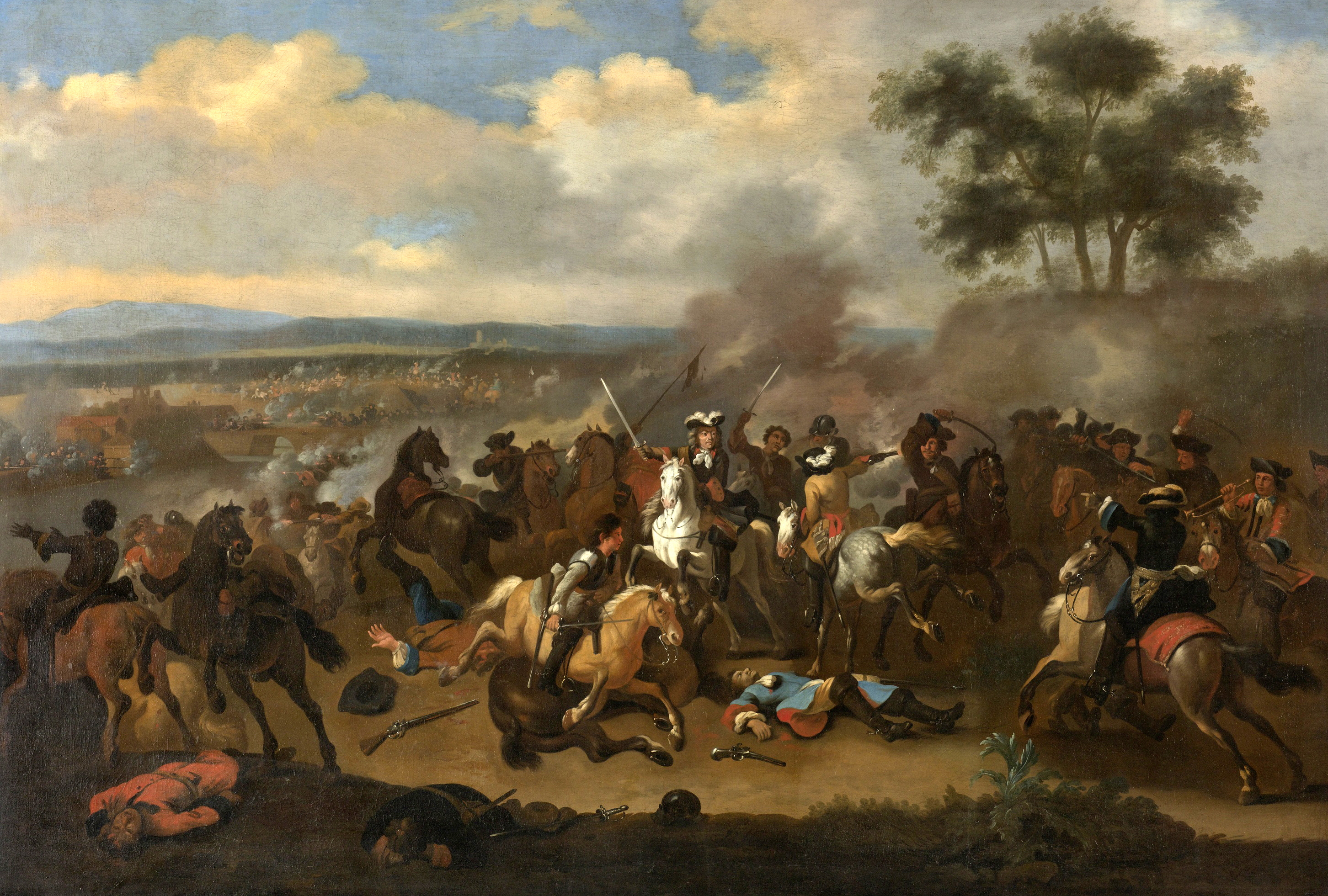
The battle took place on 1 July 1690 O.S. William's forces defeated James's army, which consisted mostly of raw recruits. Although the Williamite War in Ireland continued until the signing of the Treaty of Limerick in October 1691, James fled to France after the Boyne, never to return.
Background
The battle was a major encounter in James's attempt to regain the thrones of England and Scotland, resulting from the Invitation to William and William's wife, Mary, from the 'immortal seven' English peers to take the throne to defend Protestantism. But the conflict had broader and deeper European geopolitical roots, of the League of Augsburg and the Grand Alliance against the expansionist ambitions of Catholic Louis XIV of France, or of the House of Bourbon against the House of Habsburg.[1][2][3][4][5] If the battle is seen as part of the War of the Grand Alliance, Pope Alexander VIII was an ally of William and a friend to James; the Papal States were part of the Grand Alliance with a shared hostility to the Catholic Louis XIV of France, who at the time was attempting to establish dominance in Europe and to whom James was an ally.[6]
The previous year William had sent the Duke of Schomberg to take charge of the Irish campaign.[7] He was a 74-year-old professional soldier who had accompanied William during the Glorious Revolution. He brought an army of 20,000 men, which arrived at Bangor. Under his command, affairs had remained static and very little had been accomplished, partly because the English troops suffered severely from fever[8] and the army's move south was blocked by Jacobite forces; both sides camped for the winter.[1]
In an Irish context, the war was a sectarian and ethnic conflict, in many ways a re-run of the Irish Confederate Wars of 50 years earlier. For the Jacobites, the war was fought for Irish sovereignty, religious tolerance for Catholicism, and land ownership. The Catholic upper classes had lost or had been forced to exchange almost all their lands after Cromwell's conquest, as well as the right to hold public office, practice their religion, and sit in the Irish Parliament.[9] To these ends, under Richard Talbot, 1st Earl of Tyrconnel, they had raised an army to restore James II after the Glorious Revolution. Sir James Fitz Edmond Cotter being the commander-in-chief of all King James's forces in the counties of Cork, Kerry, Limerick, and Tipperary.[10] By 1690, they controlled all of Ireland except for Derry and Enniskillen.[1] The majority of Irish people were Jacobites and supported James II due to his 1687 Declaration of Indulgence or, as it is also known, the Declaration for the Liberty of Conscience, that granted religious freedom to all denominations in England and Scotland and also due to James II's promise to the Irish Parliament of an eventual right to self-determination.[11][12]
Conversely, for the Williamites in Ireland, the war was about maintaining Protestant rule in Ireland. They feared for their lives and their property if James and his Catholic supporters were to rule Ireland, nor did they trust the promise of tolerance, seeing the Declaration of Indulgence as a ploy to re-establish Catholicism as the sole state religion. James had already antagonised English Protestants with his actions. In particular, they dreaded a repeat of the Irish Rebellion of 1641, which had been marked by widespread killing. For these reasons, Protestants fought en masse for William of Orange. Many Williamite troops at the Boyne, including their very effective irregular cavalry, were Ulster Protestants, who called themselves "Enniskilliners" and were referred to by contemporaries as "Scots-Irish". These "Enniskilliners" were mostly the descendants of Anglo-Scottish border reivers; large numbers of these reivers had settled around Enniskillen in County Fermanagh.[13][14]
Commanders
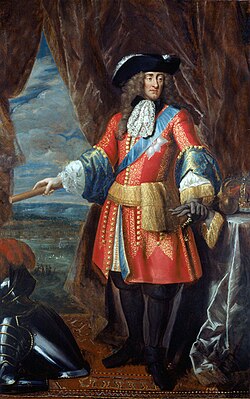
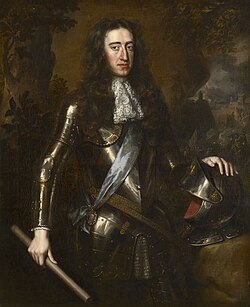
The opposing armies in the battle were led by the Roman Catholic king James II of England and Ireland (VII of Scotland) and, opposing him, his nephew and son-in-law, the Protestant king William III ("William of Orange") who had deposed James the previous year. James's supporters controlled much of Ireland and the Irish Parliament.[2][15] James also enjoyed the support of his cousin, Louis XIV, who did not want to see a hostile monarch on the throne of England. Louis sent 6,000 French troops to Ireland to support the Irish Jacobites.[16] William was already Stadtholder of the Netherlands and was able to call on Dutch and allied troops from Europe as well as England and Scotland.[15]
James was a seasoned officer who had proved his bravery when fighting in Europe,[2] notably at the Battle of the Dunes.[17] However, recent historians have suggested that he was prone to panicking under pressure and making rash decisions,[18] which it has been suggested may have been due to poor health associated with the Stuart line.[2][19]
William, although a seasoned commander,[20] had yet to win a major battle. William's success against the French had been reliant upon tactical manoeuvres and good diplomacy rather than force.[20][15] His diplomacy had assembled the League of Augsburg,[21] a multi-national coalition formed to resist French aggression in Europe. From William's point of view, his taking power in England and the ensuing campaign in Ireland was just another front in the war against France in general, and Louis XIV in particular.[22]
James II's subordinate commanders were Richard Talbot, 1st Earl of Tyrconnell, who was Lord Deputy of Ireland and James's most powerful supporter in Ireland; Sir James Fitz Edmond Cotter, Brigadier General in command of all the Jacobite forces in counties Cork, Kerry, Limerick and Tipperary, and an intimate of James II; and the French general Lauzun.[23] William's commander-in-chief was the Duke of Schomberg. Born in Heidelberg, Germany, Schomberg had fought for a few different countries and had formerly been a Marshal of France, but, being a Huguenot, was compelled to leave France in 1685 because of the revocation of the Edict of Nantes.[24][25]
Armies
The Williamite army at the Boyne was about 36,000 strong, composed of troops from many countries;[26] Only around half of them were British.[27] Around 20,000 troops had been in Ireland since 1689,[28] commanded by Schomberg.[26] William himself had landed in Carrickfergus on 14 June O.S. He met Schomberg at nearby Whitehouse, and then proceeded south through Belfast.[29] Loughbrickland was the rallying point of the scattered divisions of the army.[30][31] He arrived there with another 16,000 in June 1690.[32] On 30 June O.S. William had reached the top of a hill near the southern border of County Louth.[30]
William's troops were generally far better trained and equipped than James's.[26] The best Williamite infantry were from Denmark (7000) and the Netherlands (6000), professional soldiers equipped with the latest flintlock muskets.[1][33] The Danish infantry was commanded by General Ernst von Tettau. There was also a large (3000) contingent of French Huguenot troops fighting with the Williamites.[33] William did not yet have a high opinion of his English and Scottish troops, with the exception of the Ulster Protestant "skirmishers" who had held Derry in the previous year; the English and Scottish troops were felt at this stage to be politically unreliable, since James had been their legitimate monarch up to a year before. Moreover, they had only been raised recently and had seen little action.[34] However, this battle would give William cause to evaluate them more favourably, due to the impressive behaviour of the English troops, such as the Duke of Beaufort's Regiment of Foot.[35]
James’s flag was erected at the town of Donore, on the opposite side of the river Boyne.[30] The Jacobites were 23,500 strong.[26] James had several regiments of French troops, but most of his manpower was provided by Irish Catholics, with some English and Scottish Jacobites also present. The Jacobites' Irish cavalry, who were recruited from among the dispossessed Irish gentry, proved themselves to be high-calibre troops during the course of the battle.[36] However, the Irish infantry, predominantly peasants who had been pressed into service, were not trained soldiers. They had been hastily trained, poorly equipped, and only a minority of them had functional muskets. In fact, some of them carried only farm implements such as scythes at the Boyne.[37] Furthermore, the Jacobite infantry who actually had firearms were all equipped with the obsolete matchlock musket.[1] The French and Irish troops wore a white rallying mark, as a compliment to the Bourbons and to distinguish them from the Williamites.[30]
Battle
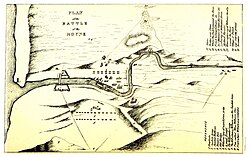
- Drogheda
- Jacobite army
- Jacobite batteries
- Donore
- Oldbridge
- William’s line of march from Ardee
- A small hamlet
- The Williamite Camp
- The hill whence William saw the Jacobite camp
- Pass called King William’s Glen
- Place where William was wounded
- Slane
- Bridge near Slane
- Where the Dutch passed the river
- French and Enniskillingers ditto
- Sir J. Hansner’s & Count Nassau’s ditto
- Left wing of William’s Horse
- Mattlock rivulet
- Where right wing of William’s army crossed the river
- Village of Duleek
- Low marshy ground
- Rosnaree
Map of the Battle of the Boyne. (South being up; west to the right.)[iv]
William sailed from Hoylake in Cheshire, landing at Carrickfergus,* County Antrim on 14 June O.S. and marched south. Referring to Dublin, he was heard to remark that "the place was worth fighting for".[30] James chose to place his line of defence on the River Boyne, around 30 mi (48 km) from Dublin. The Williamites reached the Boyne on 29 June. The day before the battle, William himself had a narrow escape when he was wounded in the shoulder by Jacobite artillery while surveying the fords over which his troops would cross the Boyne.[38]
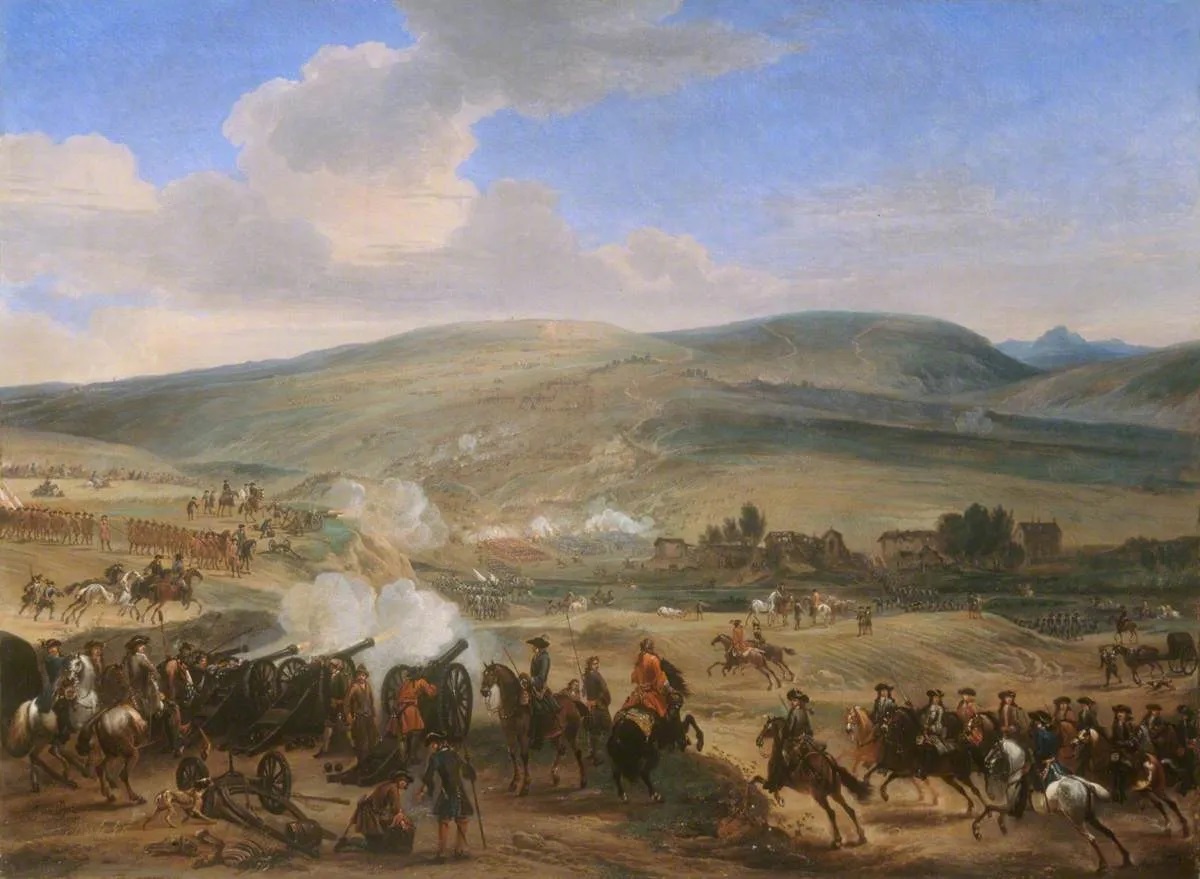
The battle itself was fought on 1 July O.S. (11 July N.S.), for control of a ford on the Boyne near Drogheda, about 2.5 km (1.6 mi) north-west of the hamlet of Oldbridge. As a diversionary tactic, William sent about a quarter of his men under the cover of morning mist to cross the river at Roughgrange, about 4 km (2.5 mi) west of Donore and about 6 mi (9.7 km) south-west of Oldbridge. The Duke of Schomberg's son, Meinhardt, led this crossing, which a small force of Irish dragoons in picquet under Neil O'Neill unsuccessfully opposed.[39] James thought that he might be outflanked and sent a large part of his army, including his best French troops along with most of his artillery, to counter this move. What neither side had realised was that there was a deep, swampy ravine at Roughgrange. Because of this ravine, the opposing forces there could not engage each other, but literally sat out the battle as artillery engaged. The Williamite forces went on a long detour march which, later in the day, almost saw them cut off the Jacobite retreat at the village of Naul.[40]
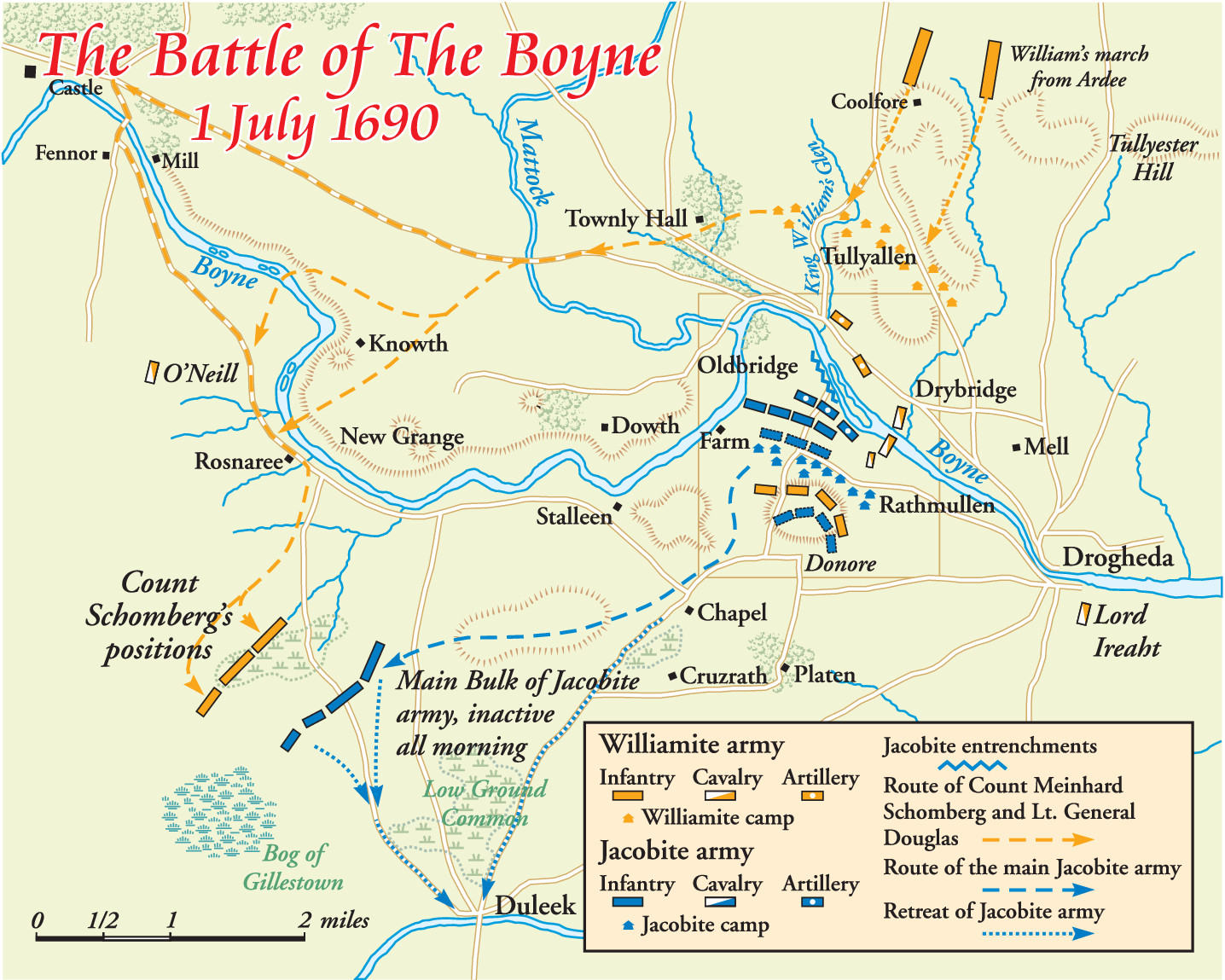
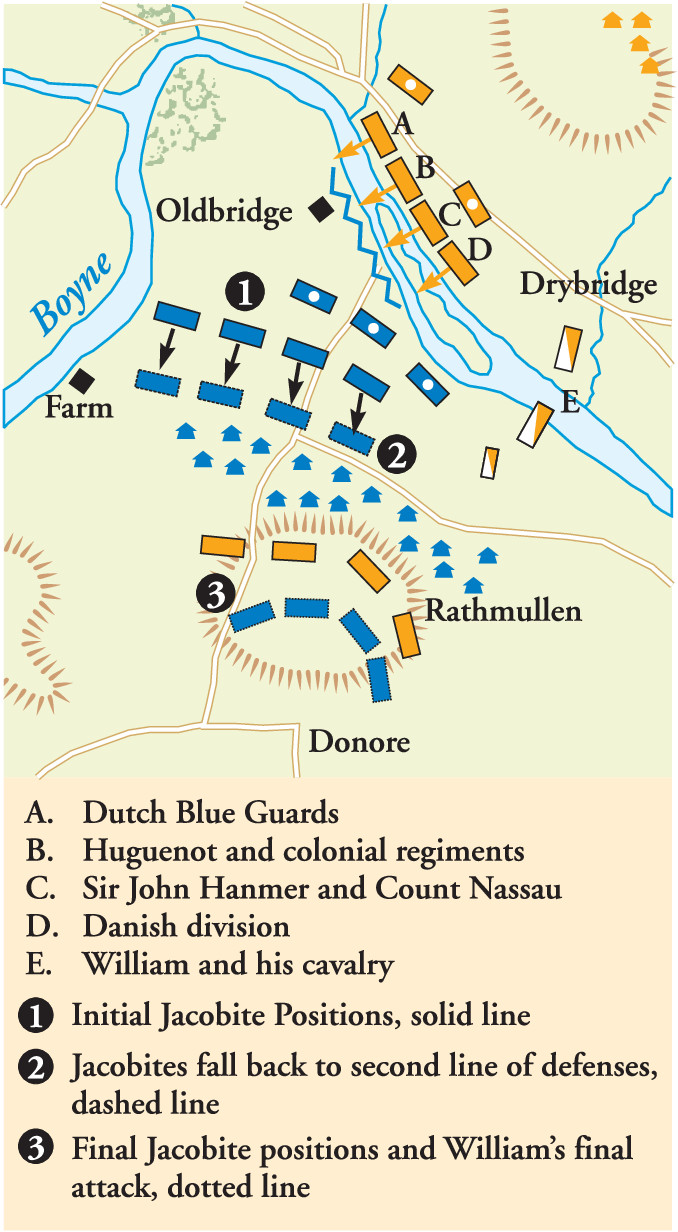
At the main ford near Oldbridge, William's infantry, led by the elite Dutch Blue Guards under Solms, forced their way across the river, using their superior firepower to slowly drive back the Jacobite foot soldiers, but were pinned down when the Jacobite cavalry, commanded by James II's son James FitzJames, 1st Duke of Berwick,[41] counter-attacked. Having secured the village of Oldbridge, the Williamite infantry tried to hold off successive Jacobite Irish cavalry attacks with disciplined volley fire, but many were scattered and driven into the river, with the exception of the Blue Guards.[42] When William saw his Dutch Guards isolated on the enemy side of the river and without any protection from natural obstacles he was extremely worried according to an eyewitness:
But when he saw them stand their ground and fire by platoons, so that the horse were forced to run away in great disorder, he breathed out…, and said he had seen his Guards do that which he had never seen foot do in his life.[43]
The Blue Guards had formed up in three separate squares and were, by using platoon fire, able to drive away the Jacobite cavalry.[42][43] The Williamites were not able to resume their advance until their own horsemen managed to cross the river and, after being badly mauled, particularly the Huguenots,[44] managed to hold off the Jacobite cavalry. William's second-in-command, the Duke of Schomberg, and George Walker were killed in this phase of the battle. The Irish cavalry finally gave up when Danish infantry commanded by Wurttemberg and cavalry led by Godert de Ginkel (about 11 or 12 squadrons), who had both crossed the river further downstream, advanced towards them.[42]
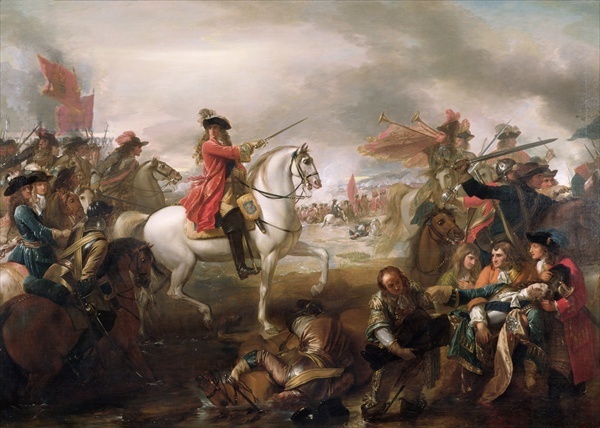
The Battle of the Boyne, painted by Benjamin West in 1778[viii]
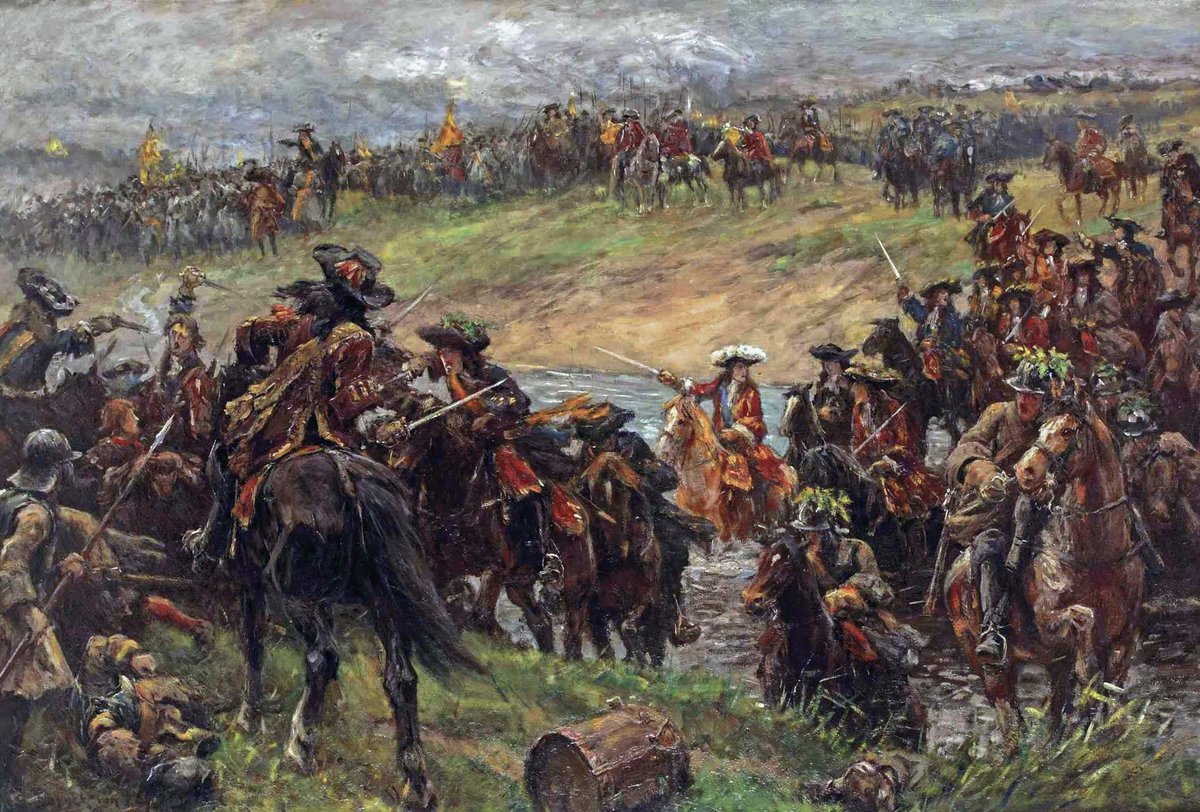
William crosses the Boyne, by Jan Hoynck van Papendrecht[ix]
The Jacobites retired in good order. William had a chance to trap them as they retreated across the River Nanny at Duleek, but his troops were held up by a successful rear-guard action. The Dutch secretary of King William, Constantijn Huygens Jr., has given a good description (in Dutch) of the battle and its aftermath, including subsequent cruelties committed by the victorious soldiers.[45]
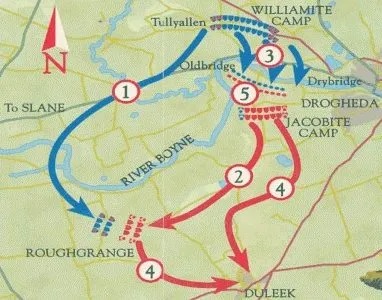
William crosses the Boyne map[x]
Map Legend & Operational Phases
- ① Williamite Flanking Movement: A diversionary force led by Meinhardt Schomberg split from the main camp at Tullyallen and moved west to cross the river near Roughgrange, threatening the Jacobite flank.
- ② Jacobite Response: Fearing they would be cut off from the road to Dublin, King James II dispatched a significant portion of his army—including his elite French infantry—westward to intercept the flanking manoeuvre.
- ③ William’s Forces Cross the Boyne: With the Jacobite centre heavily weakened by the redeployment, King William III launched his primary assault across the river near Oldbridge.
- ④ Jacobite Retreat to Duleek: Following intense hand-to-hand fighting and a breakdown of their defensive lines, the remaining Jacobite forces executed a tactical retreat south toward the bottleneck at Duleek.
- ⑤ Oldbridge Crossing Engagement: Marks the central clash where William’s elite Blue Guards and Huguenot regiments waded across the ford to secure the south bank.
The casualty figures of the battle were quite low for a battle of such a scale—of the 50,000 or so participants, about 2,000 died.[1] Three quarters of the dead were Jacobites. William's army had far more wounded. At the time, most casualties of battles tended to be inflicted in the pursuit of an already-beaten enemy; this did not happen at the Boyne, as the counter-attacks of the skilled Jacobite cavalry screened the retreat of the rest of their army, and in addition William was always disinclined to endanger the person of James, since he was the father of his wife, Mary. The Jacobites were badly demoralised by the order to retreat, which lost them the battle. Many of the Irish infantrymen deserted, abandoning clothing in their escape.[46] The Williamites triumphantly marched into Dublin two days after the battle. The Jacobite army abandoned the city and marched to Limerick, behind the River Shannon, where they were unsuccessfully besieged.
Soon after the battle, William issued the Declaration of Finglas, offering full pardons to ordinary Jacobite soldiers, but not to their leaders.
Aftermath
The battle was overshadowed in Britain by the defeat of an Anglo-Dutch fleet by the French on the previous day at the Battle of Beachy Head, a far more serious event in the short term;[47] but on the continent the Battle of the Boyne was treated as an important victory. Its importance lay in the fact that it was the first proper victory for the League of Augsburg, a precarious alliance between the Vatican and Protestant countries. The victory motivated more nations to join the alliance and in effect ended the fear of a French conquest of Europe.[48]
The Boyne also had strategic significance for both England and Ireland. It marked the beginning of the end of James's hope of regaining his throne by military means and probably assured the triumph of the Glorious Revolution. In Scotland, news of this defeat temporarily silenced the Highlanders supporting the Jacobite rising, which had been led by Bonnie Dundee who was killed the previous July at the Battle of Killiecrankie.[49] The battle was a general victory for William. Owing to the political situation mentioned above, Catholic institutions amongst William's continental allies hailed his victory with bell-ringing.[50]
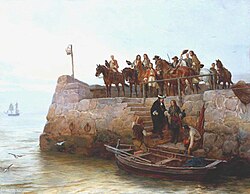
The battle caused the Jacobites to abandon the city of Dublin, which was occupied by William's forces, without a fight. Despairing of his hopes for victory, James II fled to Duncannon and returned to exile in France, even though his army left the field relatively unscathed. James's loss of nerve and speedy exit from the battlefield enraged his Irish supporters and he was derisively nicknamed Séamus a' chaca ("James the shit") in Irish.[51][52] The war in Ireland had not ended, however. The Franco-Irish Jacobite army regrouped in Limerick and fought off a Williamite assault on the city in late August. It was not until the following year and battle of Aughrim that their forces were broken and after another siege of Limerick, they surrendered to William's general Godard de Ginkel. The war in Ireland formally ended with the Treaty of Limerick in 1691. This allowed over 14,000 Irish soldiers under Patrick Sarsfield, to leave for France and allowed most Irish Catholic land owners to keep their land provided they swore allegiance to William of Orange. However, the Protestant dominated Irish Parliament rejected these terms, not ratifying the treaty until 1697—and then not in full—and imposed a tough Penal Code resented by Irish Catholics for many years.[53][54][55][56]
Commemoration
Originally, the Twelfth of July commemoration was that of the 1691 Battle of Aughrim,[57] symbolising British Protestants' victory in the Williamite war in Ireland. At Aughrim, which took place a year after the Boyne, the Jacobite army was destroyed, deciding the war in the Williamites' favour. The Boyne, which, in the old Julian calendar, took place on 1 July O.S., was treated as less important, third after Aughrim and the anniversary of the Irish Rebellion of 1641 on 23 October O.S.
In 1752, the Gregorian calendar was also adopted in Ireland.[58] However, even after this date, "The Twelfth" continued to be commemorated at Aughrim, on 12 July NS,[57] following the usual historical convention of commemorating events of that period within Great Britain and Ireland by mapping the Julian date directly onto the modern Gregorian calendar date (as happens for example with Guy Fawkes Night on 5 November). But, after the Orange Order was founded in 1795 amid sectarian violence in County Armagh, the two events were combined in the late 18th century.[57]
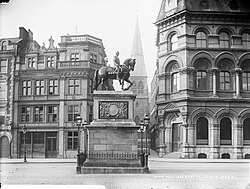
Statue of William of Orange on College Green, in Dublin, erected in 1701. It was destroyed in 1929.[xii]
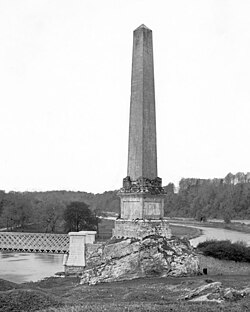
View of the commemorative Boyne Obelisk prior to 1883 (erected in 1736). It was destroyed in 1923.[xiii]
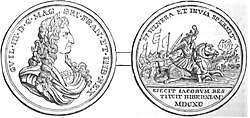
Medal struck to commemorate the Battle of the Boyne[xiv]
"The Twelfth" in Northern Ireland today
Main article: The Twelfth
The Battle of the Boyne remains a controversial topic in Northern Ireland, where some Protestants remember it as the great victory over Catholics that resulted in the sovereignty of Parliament and the Protestant monarchy.[60]
In recent decades, "The Twelfth" has often been marked by confrontations, as members of the Orange Order attempt to celebrate the date by marching past or through what they see as their traditional route.[61] Some of these areas, however, now have a nationalist majority who object to marches passing through what they see as their areas.[60]
Many[quantify] nationalists[who?] still see these marches as provocative, whilst Unionist marchers insist that it is part of their historical right to celebrate. Since the start of the Troubles, the celebrations of the battle have been seen as playing a critical role in the awareness of those involved in the unionist/nationalist tensions in Northern Ireland. Better policing and improved dialogue between the sides in the 21st century have made for more peaceful parades.[60]
"The Eleventh Night" in Northern Ireland
There are also traditions set to happen on 11 July, the eve of the Twelfth Night, known as the Eleventh Night. On this night, Protestants ignite bonfires all over Northern Ireland to celebrate the commencement of the Twelfth Night.
The reason they use bonfires to symbolize the event dates back to the pagan celebrations of Midsummer, Bealtaine and Samhain, where fire is used as a symbol of celebration.[62]
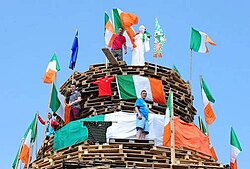
Bonfire pyre including the Tricolour flag[xv]
Many object to the use of bonfires in Loyalist celebrations today, especially because many bonfires now include "the burning of flags, effigies and election posters."[63]
Battlefield preservation
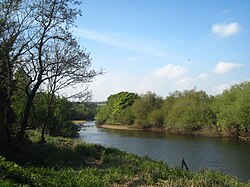
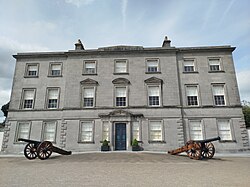
The site of the Battle of the Boyne sprawls over a wide area west of the town of Drogheda in Ireland. In the County Development Plan for 2000, Meath County Council re-zoned the land at the eastern edge of Oldbridge, at the site of the main Williamite crossing, to residential status. A subsequent planning application for a development of over 700 houses was granted by Meath County Council and this was appealed against by local historians to An Bord Pleanála (The Planning Board). In March 2008, after an extremely long appeal process, An Bord Pleanála approved permission for this development to proceed.[64] Further plans have been submitted for hundreds more homes and a link to the River Boyne Boardwalk.[65]
The Battle of the Boyne Visitor Centre at Oldbridge House is run by the Office of Public Works, an agency of the Irish government, and is about one mi (1.6 km) to the west of the main river crossing point. The battle's other main combat areas, at Duleek, Donore and Plattin, along the Jacobite line of retreat, are marked with tourist information signs.
On 4 April 2007, in a sign of improving relations between unionist and nationalist groups, the newly elected First Minister of Northern Ireland, the Reverend Ian Paisley, was invited to visit the battle site by the Taoiseach (Prime Minister) Bertie Ahern later in the year. Following the invitation, Paisley commented that "such a visit would help to demonstrate how far we have come when we can celebrate and learn from the past so the next generation more clearly understands". On 10 May, the visit took place, and Paisley presented the Taoiseach with a Jacobite musket in return for Ahern's gift at the St Andrews talks of a walnut bowl made from a tree from the site. A new tree was also planted in the grounds of Oldbridge House by the two politicians to mark the occasion.[66]
See also
The Boyne Water – Ulster Protestant folk song
Irish calendar – Gregorian calendar as it is in use in Ireland
List of conflicts in Ireland
Military history of Britain
Notes
Explanatory footnotes
The battle took place on 11 July N.S.(England changed in 1752), but the anniversary is now celebrated on 12 July. This is explained at § Commemoration below.
The "Patriot Parliament" session of the Parliament of Ireland confirmed Charles as King of Ireland, though Poynings' Law arguably made this invalid. In any case, the subsequent Act of Recognition set this aside.
Citations
- [1] "Battle of the Boyne". www.britannica.com. Archived from the original on 21 July 2021. Retrieved 6 July 2019.
- [2] "James II, King of England, Scotland and Ireland". www.britannica.com. Archived from the original on 11 August 2021. Retrieved 13 July 2019.
- [3] "The Glorious Revolution". www.parliament.uk. Archived from the original on 11 July 2021. Retrieved 1 November 2019.
- [4] "James II in Ireland". www.libraryireland.com. Archived from the original on 7 March 2021. Retrieved 1 November 2019.
- [5] "War of the Grand Alliance". www.britannica.com. Archived from the original on 29 June 2021. Retrieved 1 November 2019.
- [6] Brown, Derek (11 July 2000). "How the battle of the Boyne earned its place in history". The Guardian. Archived from the original on 26 May 2021. Retrieved 17 December 2016.
- [7] Elliott, I. D. (1973). 'Schomberg, Friedrich Hermann, Duke of' Encyclopaedia Britannica, Volume 19. London: Encyclopaedia Britannica Inc., William Benton, Publisher. p. 1174. "He went to Ireland as commander in chief against James II in August 1689...". ISBN 978-0-85229-173-3.
- [8] Elliott 1973, p. 1174. "...but [he] could do little more than hold Ulster as there was much sickness in his small army, and he took no risks.".
- [9] "Charles I (1625–49) and the Commonwealth (1649–60)". www.britannica.com. Archived from the original on 24 October 2020. Retrieved 1 November 2019.
- [10] Ó Cuív, pp. 155–157
- [11] Harris, Tim (2006). Revolution: The Great Crisis of the British Monarchy, 1685–1720. London: Allen Lane. p. 440. ISBN 978-0-7139-9759-0.
- [12] Magennis, Eoin (1998). "A 'Beleaguered Protestant'?: Walter Harris and the Writing of Fiction Unmasked in Mid-18th-Century Ireland". Eighteenth-Century Ireland. 13: 6–111. doi:10.3828/eci.1998.8. JSTOR 30064327. S2CID 256129781.
- [13] "The Inniskillings (6th Dragoons)". Archived from the original on 18 January 2008. Retrieved 1 November 2019.
- [14] Jackson, Major E. S. (2015). Inniskilling Dragoons: The Records of an Old Heavy Cavalry Regiment. Uckfield, East Sussex: The Naval & Military Press.
- [15] "William III. King of England, Scotland and Ireland". www.britannica.com. Archived from the original on 17 June 2015. Retrieved 15 July 2019.
- [16] "The Williamite War 1689–91". www.historyireland.com. 22 January 2013. Archived from the original on 16 July 2019. Retrieved 16 July 2019.
- [17] "Battle of the Dunes". www.britannica.com. Archived from the original on 26 May 2019. Retrieved 13 July 2019.
- [18] Baldwin Smith, Lacey (2006). English History Made Brief, Irreverent, and Pleasurable. Chicago: Chicago Review Press. p. 224.
- [19] Holmes, Frederick (2003). The Sickly Stuarts:The Medical Downfall of a Dynasty. Gloucester: Sutton Publishing.
- [20] Bevan, Bryan (1997). King William III: Prince of Orange, the first European. London: Rubicon Press.
- [21] Payne, George; James, Rainsford (1838). The Life and Times of Louis the Fourteenth, Volume 4. London: Samuel Bentley. p. 154.
- [22] Blom, J. C. H.; Lamberts, E., eds. (2006). History of the Low Countries (new English-language ed.). New York & Oxford: Berghahn Books. p. 196.
- [23] "Antonin-Nompar de Caumont, count and duke de Lauzun". www.britannica.com. Archived from the original on 3 June 2019. Retrieved 15 July 2019.
- [24] "Schomberg, Frederick Herman, 1st duke of". www.encyclopedia.com. Archived from the original on 16 July 2019. Retrieved 16 July 2019.
- [25] "Frederick Herman, duke of Schomberg". www.britannica.com. Archived from the original on 11 July 2019. Retrieved 16 July 2019.
- [26] The Battle of the Boyne Teachers Notes & Resources – Secondary Level Archived 25 October 2017 at the Wayback Machine (PDF) Office of Public Works (Ireland), (undated, retrieved 9 March 2017)
- [27] "Britannica-Battle of the Boyne". Britannica.com. Archived from the original on 21 July 2021. Retrieved 16 December 2020.
- [28] Laverty, Henry (producer/director) (1 January 1990). "Battle of the Boyne: Part I". Battle of the Boyne. 2:48 minutes in. BBC. Archived from the original on 1 July 2022. Retrieved 6 July 2019.
- [29] "King William's Progress to the Boyne". The Ulster Journal of Archaeology. 1: 131. 1853. JSTOR 20563454.
- [30] Macaulay, T.B. (1849). "Chapter XVI". History of England from the accession of James II (1685) until the death of William III (1702). New York: Harper.
- [31] "Two Unpublished Diaries, Connected with the Battle of the Boyne". Ulster Journal of Archaeology. 1. 4. Belfast: 80. 1856.
- [32] Ohlmeyer, Jane, ed. (2018). The Cambridge History of Ireland: Volume 2, 1550–1730. Cambridge: Cambridge University Press.
- [33] Laverty, Henry (producer/director) (1 January 1990). "Battle of the Boyne: Part I". Battle of the boyne. 2:32 minutes in. BBC. Archived from the original on 1 July 2022. Retrieved 6 July 2019.
- [34] Childs, John (2007). The Williamite Wars in Ireland. London/New York: A & C Black. pp. 33, 135.
- [35] "The Duke of Beaufort's Regiment of Foot: The Battle of the Boyne". The Keep Military Museum. 10 March 2022. Retrieved 13 July 2024.
- [36] Laverty, Henry (producer/director) (1 January 1990). "Battle of the Boyne: Part I". Battle of the boyne. 10:50 minutes in. BBC. Archived from the original on 1 July 2022. Retrieved 6 July 2019.
- [37] BBC History: The Battle of the Boyne Archived 5 December 2013 at the Wayback Machine BBC, (undated, retrieved 9 March 2017)
- [38] Lavery, Henry (producer/director) (1 January 1990). "Battle of the Boyne: Part I". Battle of the boyne. 4:05 minutes in. BBC. Archived from the original on 1 July 2022. Retrieved 21 July 2019.
- [39] Laverty, Henry (producer/director) (1 January 1990). "Battle of the Boyne: Part I". Battle of the boyne. 8:00 minutes in. BBC. Archived from the original on 1 July 2022. Retrieved 21 July 2019.
- [40] Laverty, Henry (producer/director) (1 January 1990). "Battle of the Boyne: Part I". Battle of the boyne. 9:10 minutes in. BBC. Archived from the original on 1 July 2022. Retrieved 21 July 2019.
- [41] Handley, Stuart (May 2011). "Fitzjames, James, Duke of Berwick upon Tweed (1670–1734". Oxford Dictionary of National Biography (online ed.). Oxford University Press.
- [42] Van Nimwegen 2020, p. 207.
- [43] Blackmore 2014, p. 100.
- [44] Laverty, Henry (producer/director) (1 January 1990). "Battle of the Boyne: Part I". Battle of the boyne. 11:00 minutes in. BBC. Archived from the original on 1 July 2022. Retrieved 21 July 2019.
- [45] Observaties van een Zeventiende-eeuwse wereldbeschouwer, Constantijn Huygens en de uitvinding van het moderne dagboek. Dekker, Rudolf, Amsterdam 2013 pp. 45–47.
- [46] Laverty, Henry (producer/director) (1 January 1990). "Battle of the Boyne: Part I". Battle of the boyne. 15:10 minutes in. BBC. Archived from the original on 1 July 2022. Retrieved 21 July 2019.
- [47] Macaulay, Lord (1914). The History of England from the Accession of James the Second. Vol. 4. London: Macmillan & Co. Ltd. pp. 854–858.
- [48] "War of the Grand Alliance". www.britannica.com. Archived from the original on 29 June 2021. Retrieved 31 October 2019.
- [49] "Jacobite Risings". www.oxfordreference.com. Archived from the original on 21 June 2017. Retrieved 31 October 2019.
- [50] Finn, Clodagh (9 July 2016). "Craving for a bond unlikely to lag due to a flag". Irish Examiner. Archived from the original on 31 October 2019. Retrieved 31 October 2019.
- [51] Simms, J. G. (1986). War and Politics in Ireland, 1649–1730. London & Ronceverte: The Hambledon Press. pp. 184, 203.
- [52] Szechi, Daniel (1994). The Jacobites: Britain and Europe, 1688–1788. Manchester & New York: Manchester University Press. p. 49.
- [53] "The Treaty of Limerick, 1691". www.ucc.ie/en/. Archived from the original on 31 December 2018. Retrieved 31 October 2019.
- [54] "History of the law, 1691 – present". www.courts.ie. Archived from the original on 31 October 2019. Retrieved 31 October 2019.
- [55] "Treaty of Limerick". www.encyclopedia.com. Archived from the original on 31 October 2019. Retrieved 31 October 2019.
- [56] "Battle of the Boyne: King William III's Victory in Ireland". www.historynet.com. 12 June 2006. Archived from the original on 5 October 2019. Retrieved 31 October 2019.
- [57] Lenihan, Padraig (2003). 1690 Battle of the Boyne. Tempus. pp. 258–259. ISBN 9780752425979.
- [58] ‘The Pope’s new invention’: the introduction of the Gregorian calendar in Ireland, 1583–1782, page 9 Archived 14 December 2016 at the Wayback Machine History Department, University College Cork, 1 April 2006
- [59] Chambers, Robert (1832). The Book of Days: A Miscellany of Popular Antiquities in Connection with the Calendar, Including Anecdote, Biography, & History, Curiosities of Literature and Oddities of Human Life and Character, Volume 2. London: W. & R. Chambers Limited. Archived from the original on 7 March 2022. Retrieved 7 January 2016.
- [60] "The Irish Post". Twelve things you should know about marching season in Northern Ireland on 'The Twelfth'. Dublin. 11 July 2016. Archived from the original on 17 July 2019. Retrieved 17 July 2019.
- [61] Bryan, Dominic (2000). Orange Parades: The politics of ritual, tradition and control. Pluto Press. pp. 147–148.
- [62] Corscadden, Jane (6 July 2022). "The reason bonfires are lit on the Eleventh Night in NI". BelfastLive. Retrieved 15 December 2022.
- [63] "The Twelfth: Why are bonfires lit in Northern Ireland?". BBC News. 9 July 2021. Retrieved 15 December 2022.
- [64] "224875: Oldbridge, Rathmullen Road, Drogheda, Co. Meath (SA/60260)". www.pleanala.ie/. Archived from the original on 31 October 2019. Retrieved 31 October 2019.
- [65] "Housing boom as 661 homes planned on Rathmullen Road". www.independent.ie. 25 October 2019. Archived from the original on 31 October 2019. Retrieved 31 October 2019.
- [66] "Paisley and Ahern visit 1690 site". BBC News. 11 May 2007. Archived from the original on 20 May 2022. Retrieved 22 November 2019.
Images
- [i] Painting of the battle by Jan van Huchtenburg — lead illustration on this page (cropped detail). De slag aan de Boyne (Ierland) tussen Jacobus II en Willem III, 12 juli 1690. Rijksmuseum object SK-A-605. This file is made available under the Creative Commons CC0 1.0 Universal Public Domain Dedication.
- [ii] James II, King of England and Ireland, James VII of Scotland, 1685–1688, portrayed as head of the army c. 1685) Attributed to Benedetto Gennari II — nam.ac.uk Public domain. King James II (1633-1701) portrayed in his role as head of the Army, wearing a General Officer's State coat
- [iii] William III ("William of Orange"), King of England, Scotland and Ireland, 1689–1702, Stadtholder in the Netherlands, 1672–1702 Willem Wissing — Royal Collection Trust Public domain. Portrait of William III of England, when Prince of Orange
- [iv] This file is from the Mechanical Curator collection, a set of over 1 million images scanned from out-of-copyright books and released to Flickr Commons by the British Library in London, England. Public Domain
- [v] The Battle of the Boyne, painted by Jan Wyck — Jan Wyck Public Domain
- [vi] Boyne position 1 map — https://warfarehistorynetwork.com/article/king-billy-at-the-boyne-river/
- [vii] Boyne position 2 map — https://warfarehistorynetwork.com/article/king-billy-at-the-boyne-river/
- [viii] The Battle of the Boyne, painted by Benjamin West in 1778 Benjamin West — www.affordablehousinginstitute.org Bridgeman Images Public Domain. King William III at the Battle of the Boyne, 1 July 1690 (O. S.)
- [ix] William crosses the Boyne, by Jan Hoynck van Papendrecht Jan Hoynk van Papendrecht — Jan Hoynck van Papendrecht Public Domain. William of Orange crosses the Boyne during the Battle of the Boyne, 1690
- [x] William crosses the Boyne map — keepmilitarymuseum.org
- [xi] A Lost Cause by Andrew Carrick Gow, 1888. James II departing for France from Kinsale following the Boyne. Andrew Carrick Gow — Art UK
- [xii] Statue of William of Orange on College Green, in Dublin, erected in 1701. It was destroyed in 1929. National Library of Ireland on The Commons — Flickr Commons Direct NLI link: catalogue.nli.ie/Record/vtls000324208 No restrictions. Statue of William III aka William of Orange on College Green/Dame Street in Dublin. From National Library of Ireland (Commons) collection. Original by Robert French (1841-1917 photographer). Released by National Library of Ireland under Commons.
- [xiii] View of the commemorative Boyne Obelisk prior to 1883 (erected in 1736). It was destroyed in 1923. unknown, 19th Century — postcard Public Domain. The Boyne Obelisk
- [xiv] Medal struck to commemorate the Battle of the Boyne. Robert Chambers (1832) — Google Books Public Domain. Medal Struck to Commemorate the Battle of the Boyne (Robert Chambers, p.8, July 1832)
- [xv] Bonfire pyre including the Tricolour flag Jtcorscadden — Own work CC BY-SA 4.0. Bonfire for the Eleventh Night in Northern Ireland
- [xvi] River Boyne at Oldbridge in 2011 Rod Allday CC BY-SA 2.0. River Boyne at Oldbridge, Co. Meath in 2011
- [xvii] Battle of the Boyne Visitor Centre Sheila1988 — Own work CC0. Oldbridge House, Battle of the Boyne Museum
Further reading
Doherty, Richard (1998). The Williamite War in Ireland 1688–1691. Dublin: Four Courts Press. ISBN 1-85182-375-1.
Hayes-Mac Coy, G. A. (1990). Irish Battles. Belfast: Appletree Press. ISBN 0-86281-250-X. OCLC 231283129.
Lenihan, Padraig (2003). 1690: Battle of the Boyne. Stroud, Gloucestershire, UK: Tempus Publishing. ISBN 0-7524-3304-0. OCLC 61303112.
Van Nimwegen, Olaf (2020). De Veertigjarige Oorlog 1672–1712: de strijd van de Nederlanders tegen de Zonnekoning (The 40 Years War 1672–1712: the Dutch struggle against the Sun King) (in Dutch). Prometheus. ISBN 978-90-446-3871-4.
Blackmore, David (2014). Destructive & Formidable: British Infantry Firepower, 1642–1756 (PDF). Frontline Books.
External links
Battle of the Boyne visitor centre at Oldbridge, plus battle information
Boyne Valley Tourist Portal – Information on Battle of the Boyne
Tourist Information on Battle of the Boyne Visitor Centre
Primary and secondary sources relating to the Battle of the Boyne (From the National Library of Ireland's Sources database)
Modern mapping of the area Archived 13 February 2019 at the Wayback Machine Ordnance Survey Ireland Choose "Base history and mapping" then "Historic 6-inch mapping" and enter 704444,776167 to see the site of the "Boyne Obelisk" (destroyed, 1923) on the northern side of the [subsequent] bridge.
Interview with historian Padraig Lenihan on the Battle of the Boyne
King Billy at the Boyne River - Warfare History Network — With the help of Catholic mercenaries on both sides, the fate of the English crown would be decided on the marshy banks of the Boyne River. By Eric Niderost; Military Heritage, February 2006.
Book written in 1693 and entitled "Story's Wars in Ireland" also "An Impartial account of William's Wars in Ireland", by Dean George Story who was a Chaplain in William's Army and was in London when the army was being recruited. This book can be found in the British Library Catalogue and apparently a copy is also at the Linen Hall in Belfast.
Extract from “The Battle of the Boyne” in the BBC History archive:
[*] * William himself stepped ashore at the northern port of Carrickfergus on 14 June 1690, where this pale asthmatic monarch, his face lined with the constant pain of fighting ill health, said in halting English that he had come to ensure the people of Ireland would be "settled in a lasting peace". William is celebrated to this day as a champion of Protestantism, but he was nonetheless backed by the head of the Catholic Church, Pope Alexander VIII. The Pope was part of a ´Grand Alliance´ against Louis XIV´s warring in Europe and supported William´s reconquest of Ireland.
William was known for his sometimes reckless courage and the Boyne was no different. He decided to investigate the river´s crossing points for himself and was shot at by Jacobite officers. It was rumoured that William was dead, but a bullet had only grazed his shoulder. He shrugged it off, reputedly saying: "Ce boulet est venu bien pres. Ce n´est rien" ("The ball came close enough, but it´s nothing"). After four hours of fierce fighting a significant body of William´s men had made it across to the Boyne´s southern riverbank. James´ cavalry had them pinned down, but they held and James gave the order to retreat. A rout was avoided by Louis XIV´s cavalry covering the withdrawal. Despite his army retreating in good order, James abandoned them and returned to exile in France. William marched into Dublin and finally secured his reconquest of Ireland with the Treaty of Limerick in 1691. William´s victory ended James II´s hope of regaining his throne. William was now securely in control of England, Scotland and Ireland, which would ultimately help him to reverse Louis XIV´s military conquests in Europe. For Protestants, it secured their ascendancy in Ireland. In Ulster it ensured the survival of the Protestant, English-speaking colonies known as the Plantation. The victory is still celebrated every 12 July in Northern Ireland by the Orange Order, named for William of Orange.
Why 12 July? The Battle of the Boyne was fought on 1 July 1690, according to the old Julian calendar. This was reformed and replaced with the Gregorian calendar across the British Empire in 1752, repositioning the ´date´ of the Battle of the Boyne to 11 July. The method of altering historical dates was somewhat complicated, with eleven days being added to ´old style´ dates occurring after 1700, but only ten days to those taking place before that.
BBC. “The Battle of the Boyne.” BBC History, 2014. Internet Archive Wayback Machine, web.archive.org/web/20170817025446/https://www.bbc.co.uk/history/events/battle_of_the_boyne.